
This post was originally published January 19, 2011. Some links may no longer function, and others have been updated where I can find them
Welcome back to the AstroJargon of the whatever-time-frame-I-feel-like series! Here I break down some commonly used terms in astronomy so that the language barrier between scientists and science lovers can be breached. Today I’d like to explain the S-Z Effect, SZE, or Sunyaev-Zel’dovich Effect. I’ve already touched upon this briefly over on Discovery. I wanted to give a bit more of an explanation than just “holes” or “shadows” that is often said in the science media. After all, what does it mean for a galaxy cluster to have a shadow?

Galaxy clusters appear to be exactly what they sound like: groupings of galaxies physically bound together by gravity. They make up the largest bound structures in the universe. There is, however, so much more that they eye cannot see about these guys. Galaxy clusters appear to be dominated by dark matter, which was famously detected in the merging galaxy clusters known collectively as the Bullet Cluster. In fact the baryonic matter that makes up you, me, the planets, the stars, and everything “normal” is just one-fifth of the total mass of a given cluster. As fascinating as dark matter is, however, that doesn’t play into this particular story.
If you just look at the “normal” matter in a cluster, the galaxies themselves only make up a small percentage, just one-sixth of that. The cluster mass is actually dominated by hot gas between the galaxies. This gas is so hot. (How hot is it?!) At 10,000,000 degrees Kelvin, it glows in X-rays, which is why many distant clusters have been detected by x-ray telescopes. (Very generally, hotter things have faster moving particles, which give off higher energy light.) However, the SZE doesn’t directly use x-rays either.
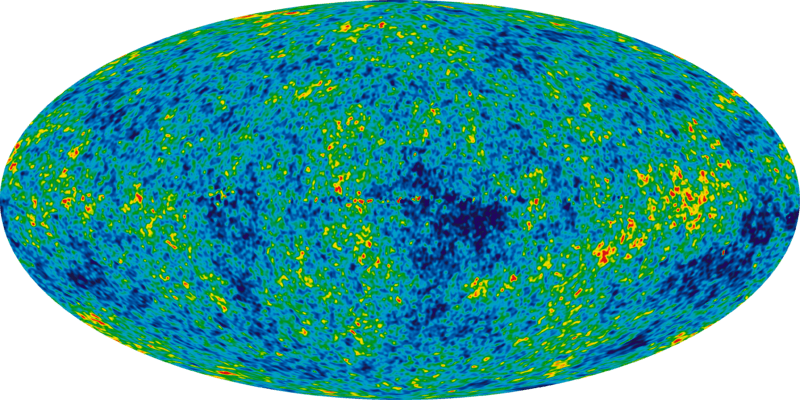
Let’s first back up and look at the light from the Cosmic Microwave Background (CMB) which originated from everywhere when the universe was 400,000 years old. This has been redshifted all the way to the microwave regime for us. However, some of those distantly created photons interact with the hot gas in galaxy clusters before coming to us. The photon, or particle of light, interacts with a gas particle, leaving with a bit more energy than it came with. This moves the photon to a smaller wavelength in a process called Compton scattering.
So, if you look in the direction of a galaxy cluster at the right wavelength for the CMB, you will see that “hole” or darker patch because the photons cannot be detected there anymore. When you look at that same spot at shorter wavelength of microwave light, you get a bright spot! The ESA’s Planck mission is especially adept at seeing this phenomenon because it covers so many wavelengths.

Interestingly, when you work out the math, the Sunyaev-Zel’dovich effect happens just as strongly for very distant clusters as it does for nearby cluster. So, really, we can probe the largest size scales of the universe all the way back billions of years with this method! Don’t get me wrong now, this isn’t a breeze to do. I remember one of my fellow NRAO summer students working on such a project, explaining just how hard it is to image a HOLE in a picture! (Lots of negative components in her CLEAN model, for those with an interferometry background.)
So, I hope you enjoy that cool bit of astrophysics and the very powerful S-Z Effect. When you see a story about Planck “seeing shadows of galaxy clusters” you’ll know what that means!
 One Astronomer's Noise
Leave a comment